
Product
Product
News
Featured
Contact Us
Contact: POWER DUKE
Phone: +86 18059884790
E-mail: plc66@qq.com
Add: fujian xiamen
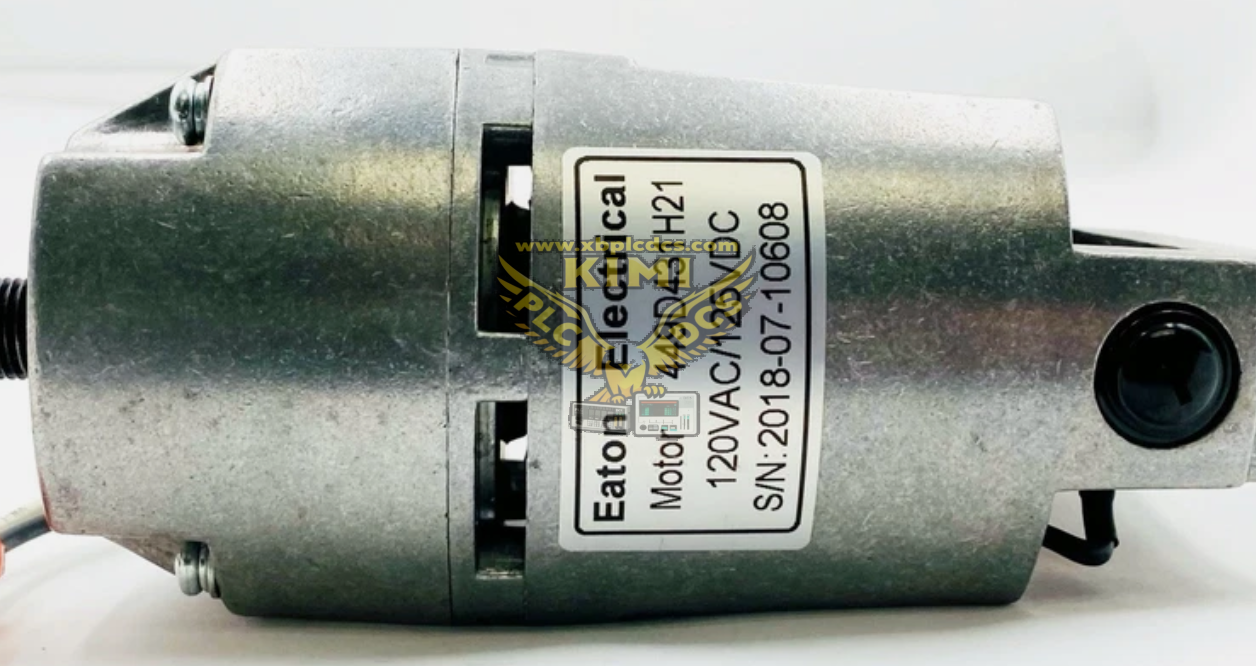
Eaton 449D431H22 Spring Charging Motor
- Warehouse: Spot
- Warranty: 365 days
- Quality: Original module
- Condition: New
- Shipping method: Courier delivery
- Contact person: LI MING
- Contact number: +86 18059884790
- WeChat:18059884790
- E-mail: plc66@qq.com
Product Description
Eaton 449D431H22 Spring Charging Motor
Product Description
449D431H22 is a spring charging motor manufactured by Eaton for medium‑voltage circuit breakers. It accepts dual‑rating 240V AC / 250V DC power supply. This compact, rugged geared motor assembly is installed inside switchgear cabinets. Its mechanical output drives the spring mechanism of circuit breakers to store closing energy automatically after each breaker operation. Designed for continuous cyclic operation in industrial power systems, it features a durable metal housing and built‑in limit switch for automatic stop once spring charging completes.
Product Functions
- Automatically charge the closing spring after circuit breaker trips or closes
- Built‑in limit switch cuts off motor power when spring is fully charged
- Provide mechanical power reserve for rapid reclosing of switchgear
- Adapt to both AC and DC control power in electrical substations
- Transmit spring‑charged status signals to local control panel and SCADA system
- Withstand vibration and temperature changes inside high‑voltage switchgear rooms
Application Scenarios
- Medium‑voltage metal‑clad switchgear and power distribution cabinets
- Power plant auxiliary electrical systems and industrial substations
- Oil, gas and petrochemical plant internal power distribution networks
- Mine, water treatment and large manufacturing factory power rooms
- Commercial building main electrical distribution systems requiring quick reclosure
Common Problems
- Motor runs continuously without stopping: Damaged limit switch, stuck mechanical cam or wiring short‑circuit.
- Motor hums but fails to charge spring: Worn internal reduction gears, insufficient supply voltage or mechanical jamming.
- No rotation when energized: Open coil winding, loose terminal connections or failed control relay contacts.
- Intermittent charging failure: Vibration‑induced loose wiring, aging brushes or poor cabinet ventilation causing overheating.
- Excessive noise during operation: Gear lubrication depletion, mechanical misalignment or bearing wear.
Related recommendations